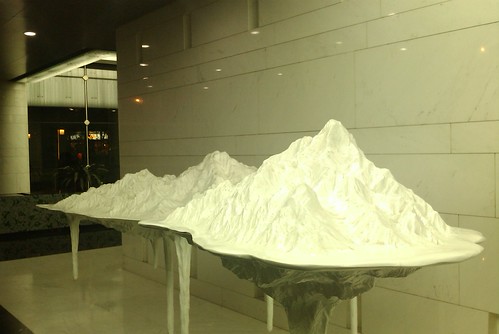
Talking about the future is a very abstract thing to do. It’s hard to relate action in the present to a particular future. Even if you’re convinced of a link between doing certain things today and how the world will look later as a result, it’s difficult to really internalise that relationship if there’s any kind of gap between cause and effect. But, of course, there usually is a gap, and when talking about the future that gap is usually years or decades.
I’ve been thinking about ways to make that connection between present action and future circumstance more visible. There’s a lot of existing work that concentrates on generating material artefacts that can be imagined to come from some future, from people producing things like ‘design fictions’, ‘experiential scenarios’, ‘diagetic prototypes’, or similar. This sort of approach is unquestionably a more engaging and effective communication tool than the text-based scenarios more usually generated by futures work. I think they’re much better at catapulting your imagination into some future time – they’re a fantastic way of making the future less abstract. But they are quite static, arriving fully-formed in the present (at least for those people who aren’t involved in the process of creating these imaginary future artefacts). And the thing that’s been exercising me in particular about the future is the way it goes from being an immaterial and uncertain possibility to a material and certain fact. As time progresses and people keep doing things, what were abstract potential outcomes become real and definite. The dynamic nature of that process, and the way it takes place in a single location, is sometimes lost in traditional futures communications. I end up with a sense that we in the present are in one place, and the people in the future are in another place, and there’s no connection between them.
What if there was a way of making an object that became more real as time went by? One linked to a particular future, so as that future became more likely or more established, as yours or other people’s actions tended towards bringing it about, the object would become more real, more extended in our present world. What if you could see a tangible future unfold in front of you?
I’m imagining some sort of form that gets generated within a constraining template at a rate that corresponds to the progress of a set of indicators. The template stands for a particular willed future, or perhaps a feared future: the indicators are the facts about the world that have been chosen to represent this future. They might be measures of particular substances in the environment, or data from organisational activity, or records of the movement of certain organisms. You’d need to have done a lot of work to establish what sort of data you’d accept as a measure of your future arriving, and what compromises you’d accept in your model.
This arrangement makes it possible to collapse a multidimensional set of indices into a single answer to the question “is it closer or further away?”. It’s the opposite of a big data dashboard, in that sense: rather than representing multiple streams of data that the viewer may or may not be equipped to parse and interpret, it relies on you to have settled on an outcome and a model and then just tells you how things are progressing. Not which things, or which ones are moving faster, or which ones are retarding progress—there are lots of tools that help you do that already—just how they’re all doing cumulatively. This is a way of refocussing on the big picture.
So what does it actually look like? Well, it would need to have a mechanism for growing or building, and a network interface for communicating the current state of the model. It could be something like:
- coloured gas in a transparent, unreflective container, gradually condensing into a solid form.
- successive layers of material laid down by tiny nanobots
- a wire form gradually colonised by ferrous crystals stimulated by varying degrees of current.
- a solid cube that degrades faster or slower in different places to reveal the future inside (perhaps the whole thing rots if progress ceases)
- a scaffolding armature along which tiny builder robots zip horizontally or vertically with Lego blocks, laying down the future one brick at a time
- a bonsai tree whose twists and turns represent inflections in the data, turbulence in the future history of your chosen world
Whatever form is chosen, it ought always to be started partly built, reflecting the historically contingent nature of the future – there are latent futures already with us, future societies and environments not yet visible but in progress. And ideally it would just run on its own, with minimal input from the person tending it: if you want to change the shape, act differently.
Speaking of contingency, the networked nature of this object would make it possible to take the output of other similar objects as an input. We could have a networked forest of futures in different stages of becoming, co-operating or competing or in a dynamic equilibrium.
So an object like this – and the corresponding effort to imagine and model a possible future to shape it – clearly poses some important philosophical issues about time and the way we are able to represent change and possibility. But what sort of practical purpose could you put it to? Maybe you could use it to:
- Support work towards a common goal – perhaps teams that are distant or working in different fields could each have an object that made their common progress visible.
- Make progress in a complex situation more visible – environmental issues, for example, are often hard to grasp due to their multifaceted character
- Give a whole community some insight into a local or global issue – having a large-scale future object as a public installation could support local efforts to work for a shared environmental or social future, perhaps linked to air quality monitoring stations or local crime reports.
- Connect to existing project management or modelling tools – a Basecamp plugin for a desk-based version might be a useful way for individuals to stay focussed on the big picture.
Really, anything that you’re happy to track could be used as an input. My feeling is that it becomes more valuable as a way of representing the not-yet-here as more dimensions are included in the model. If you only have one thing to track a church thermometer would do a better job. But for representing complex futures that are the result of hundreds of social, economic and environmental interactions, without inviting the viewer to drown in a sea of reports and visualisations, this kind of object might have an important role to play.
Of course, there’s a lot to be done to make one of these real. If I had a chance to try making one I think there are three distinct areas of work:
- Materiality: what actually works? I’d like to work with designers, technologists and materials scientists to explore the different approaches outlined above, and find a way of growing structures at a controlled rate that’s safe and reliable enough for domestic or office use.
- Modelling: obviously this is far from a new field, but in the context of this project, what kinds of model offer the most potential? What sort of outputs are most useful? What kind of detail is necessary? How do you ensure such a reductive approach to the future is productive? I could learn a lot from speaking to economists, climate scientists, programme evaluators and other people used to trying to quantify the unquantifiable.
- User experience: what sort of response do people have to these objects? What kind of form do people relate to most readily? How do you communicate the context around the form so that it isn’t taken for the only future but just one possible future?
I’d love to have a go, I think. It would be a fascinating project, dealing with knotty metaphysical issues and practical challenges, and all in the service of helping people understand what kind of futures they’re making.